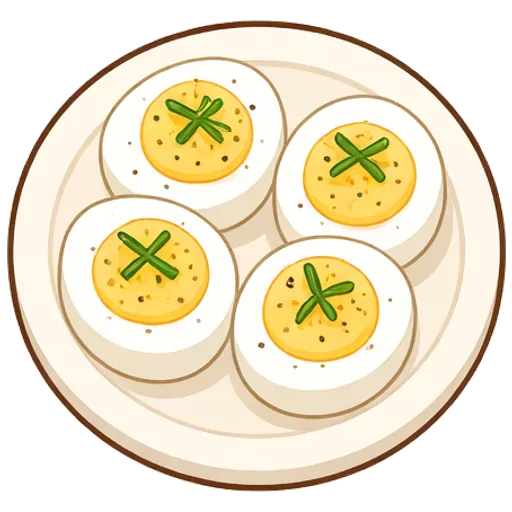
Classic deviled eggs
Creamy, tangy deviled eggs with dijon and a dusting of paprika, a two-bite snack that’s much easier than it looks.
- 30 min total
- 15 min hands-on
- Anyone can make this
- Serves 6
- About $0.39 a serving
- 120 calories
- Good the next day
- Vegetarian
- Gluten-free
- Dairy-free

Dolly says: It’s ready in 30 minutes, start to finish.
Ingredients
For 6 servings.
- 6 large eggs, straight from the fridge
- 3 tbsp mayonnaise
- 1 tsp Dijon mustard
- 1 tbsp chives, finely chopped (optional)
From your pantry
- 6 cups water
- 1 tsp apple cider vinegar
- ¼ tsp salt
- 1 pinch black pepper
- 1 pinch paprika
Each serving has about 120 calories, 6 g protein, 1 g carbs and 10 g fat, and costs about $0.39 at typical US grocery prices. Both are estimates from what the recipe uses.
Missing something?
- No chives? Green onions work.
Steps
Tap an underlined word for a quick explanation.
Set the eggs in a medium , cover them with cold water by an inch, and over high heat.
Saucepan. A saucepan is a pot with tall, straight sides and one long handle. It’s for things that need depth, like rice, sauces or a few boiled eggs.
How you’ll know: The food fills it about halfway, leaving room to bubble without spilling over.
Bring to a boil. It means heating a liquid on high until it’s fully boiling before you move on. A lid on the pot gets it there faster, which makes it a good moment to chop something.
How you’ll know: Big bubbles break all over the surface, and they keep coming when you lift the lid.
High heat
As soon as it , turn off the heat, put the lid on, and leave the eggs in the hot water for 12 minutes.
Boil. Boiling means heating a liquid until big bubbles rise and break all over the surface. It’s the fastest way to cook pasta, potatoes and eggs, because it’s as hot as water gets.
How you’ll know: Bubbles are breaking across the whole surface, not just at the edges, and steam is rising.
Timer: 12 min
 Dolly’s tip: Twelve minutes gives fully firm yolks with no green ring.
Food safety: For the safest eggs, cook until the whites are fully set and the yolks begin to thicken. Dishes made with eggs are done at 160°F.
Move the eggs into a bowl of cold water with a few ice cubes and let them cool for 5 minutes.
Timer: 5 min
Dolly’s tip: The cold stops the cooking and helps the shells slip off.Tap each egg all over on the counter and it under a trickle of running water.
Peel. Peeling means removing the skin with a vegetable peeler or a small knife. It takes off tough or bitter skins, though potato and carrot skins are fine to leave on unless the recipe insists.
How you’ll know: The color underneath is even all over, with no patches of skin left behind.
Dolly’s tip: Start at the wide end, where there’s a little air pocket. The shell comes away in big pieces.the eggs and pop the yolks out into a bowl.
Halve. Halving means cutting something into two equal pieces. Even halves cook at the same speed, so one doesn’t dry out while the other finishes.
How you’ll know: The two pieces look like mirror images of each other.
Lengthwise. Lengthwise means cutting along the long side, from stem to tip, which gives long pieces. Crosswise is the other way, straight across the middle, which gives short, round ones.
How you’ll know: Lengthwise halves of a zucchini look like two little canoes; crosswise pieces look like coins.
Mash the yolks with the mayonnaise, mustard, vinegar, salt and pepper until smooth and creamy.
Spoon the filling back into the whites, mounding it up.
Dolly’s tip: For tidy eggs, spoon the filling into a zip-top bag, snip off a corner, and squeeze it in.Dust with paprika and chives, then eat them, or keep them covered in the fridge for up to 2 days.
Dolly’s tip: Don’t leave them out of the fridge for more than 2 hours.

Plan this in Dollop, and get the grocery list
Dollop plans snacks along with the week’s dinners, puts what you need on the same grocery list, and walks you through each step.