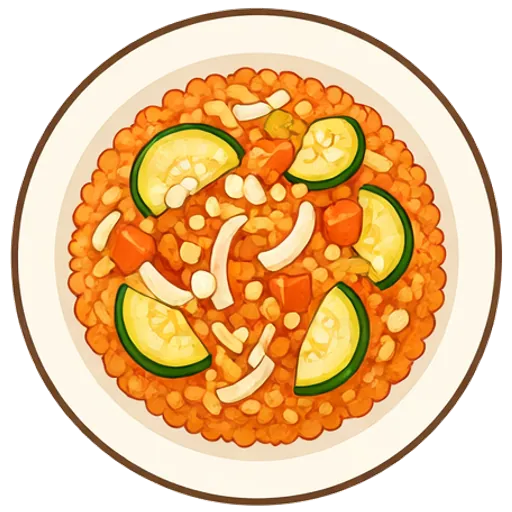
Gochujang fried rice
Leftover rice fried in sweet, spicy Korean chili paste with zucchini and carrot, then topped with a crispy fried egg.
- 25 min total
- 20 min hands-on
- Follow-a-recipe easy
- Serves 2
- About $1.67 a serving
- 650 calories
- Vegetarian
- Dairy-free

Dolly says: Read the steps once before you start. Everything goes smoother after that.
Ingredients
For 2 servings.
- 1 cup long-grain white rice, cooked and chilled, about 3 cups (leftover rice is perfect)
- ½ yellow onion, diced
- ½ zucchini, diced
- 1 carrot, diced small
- 2 cloves garlic, minced
- 2 stalks green onions, sliced
- 2 tbsp gochujang
- 1 tsp sesame oil
- 2 large eggs
- 1 tsp sesame seeds (optional)
From your pantry
- 1 tbsp soy sauce
- 1 tsp sugar
- 2 tbsp vegetable oil, divided
Each serving has about 650 calories, 16 g protein, 96 g carbs and 22 g fat, and costs about $1.67 at typical US grocery prices. Both are estimates from what the recipe uses.
Missing something?
- No long-grain white rice? Jasmine rice or basmati rice works.
- No yellow onions? White onions or red onions work.
- No zucchini? Yellow squash works.
- No green onions? Chives work.
Steps
Tap an underlined word for a quick explanation.
Break up the cold rice with your fingers. the onion, zucchini and carrot, the garlic and the green onions.
Dice. Dicing means cutting food into small, even cubes, usually a quarter to half an inch across. Pieces the same size cook at the same speed, so nothing burns while the rest catches up.
How you’ll know: Your pieces are little cubes about the size of a chickpea, and they all look close to the same.
Mince. Mincing means chopping something into the tiniest pieces you can, smaller than a grain of rice. Tiny pieces melt into the dish, so you get the flavor without biting into a chunk of garlic.
How you’ll know: Every piece is tiny and about the same size, and the pile starts to look almost like a paste.
Slice. Slicing means cutting food into flat pieces of about the same thickness. Even slices cook evenly, so none are raw while others burn.
How you’ll know: Lay a few side by side: they’re close to the same thickness from one end to the other.
Stir the gochujang, soy sauce, sugar and sesame oil together in a small bowl.
Heat 1 tablespoon oil in a large over medium-high heat. Add the onion and carrot and cook, stirring, 3 minutes, until the onion .
Skillet. A skillet is a frying pan: wide and flat with low, sloped sides. The shape lets steam escape, so food browns instead of stewing.
How you’ll know: It’s the pan you’d fry an egg in, and a 10 or 12 inch one handles most recipes.
Softened. For vegetables it means cooked until they bend and lose their crunch; for butter, left out until it dents easily. Soft onions taste sweet, and soft butter mixes in smoothly.
How you’ll know: Onions squash easily against the pan with your spoon, and butter dents under a finger without looking greasy.
Medium-high heatTimer: 3 min
Add the zucchini and garlic and cook 2 minutes more.
Medium-high heatTimer: 2 min
Add the rice and the sauce and 4 to 5 minutes, pressing the rice into the pan, until it’s evenly red, steaming hot and a little underneath.
Stir-fry. Stir-frying means cooking small pieces fast over high heat in a little oil, stirring almost constantly. It moves quickly, so have everything chopped and ready before the pan gets hot.
How you’ll know: It sizzles loudly the whole time, and the vegetables turn bright and tender-crisp in minutes.
Crispy. Crispy means the outside is dry, firm and crunchy. It comes from high heat, a little oil and room in the pan, because crowded food steams and goes soft.
How you’ll know: It sounds crunchy when you tap or bite it, and it doesn’t flop when you lift it.
Medium-high heatTimer: 4 min 30 sec
 Dolly’s tip: Gochujang has sugar in it and can scorch. If the bottom darkens too fast, turn the heat down a notch.
Food safety: Put leftovers in the fridge within 2 hours and eat them within 3 to 4 days. Reheat until steaming hot, 165°F.
Scoop the rice into two bowls and scatter the green onions over.
Add the rest of the oil to the and fry the eggs over medium heat 3 to 4 minutes, until the whites are set, the yolks start to thicken and the edges are .
Skillet. A skillet is a frying pan: wide and flat with low, sloped sides. The shape lets steam escape, so food browns instead of stewing.
How you’ll know: It’s the pan you’d fry an egg in, and a 10 or 12 inch one handles most recipes.
Crispy. Crispy means the outside is dry, firm and crunchy. It comes from high heat, a little oil and room in the pan, because crowded food steams and goes soft.
How you’ll know: It sounds crunchy when you tap or bite it, and it doesn’t flop when you lift it.
Medium heatTimer: 3 min 30 sec
Food safety: For the safest eggs, cook until the whites are fully set and the yolks begin to thicken. Dishes made with eggs are done at 160°F.
Slide an egg onto each bowl and sprinkle with sesame seeds.

Plan this in Dollop, and get the grocery list
Dollop puts this dinner on a night that suits your week, lists only what you still need to buy, and walks you through each step while you cook.
More dinners like this
Cabbage fried rice
25 min
Egg fried rice
25 min
Mushroom fried rice
25 min
Korean steamed eggs (gyeran-jjim)
30 min
30-minute dinners ›One-pan dinners ›What to make with eggs and rice ›What to make with rice and carrots ›What to make with eggs and carrots ›