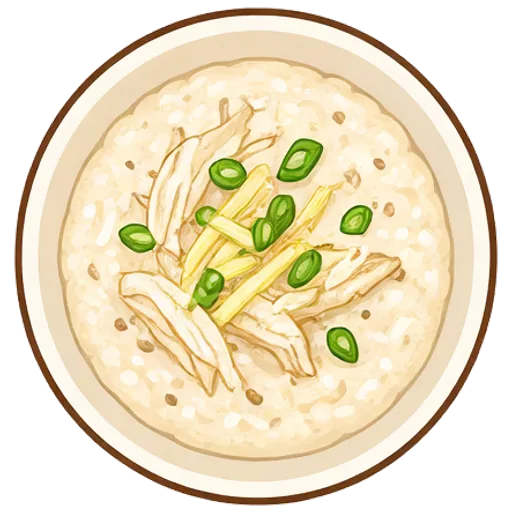
Quick chicken and ginger congee
Silky rice porridge with ginger and shredded chicken, made fast from a pouch of cooked rice, the gentlest, warmest way to start a cold morning.
- 25 min total
- 10 min hands-on
- Anyone can make this
- Serves 2
- About $3.12 a serving
- 380 calories
- Good the next day
- Gluten-free

Dolly says: It’s ready in 25 minutes, start to finish.
Ingredients
For 2 servings.
- 1 tbsp fresh ginger, peeled and grated
- 2 green onions, thinly sliced
- 1 package microwave rice pouches, any plain white rice
- 3 cups chicken broth
- 1 cup rotisserie chicken, shredded
- 2 tsp gluten-free tamari
- 1 tsp sesame oil
From your pantry
- 1 cup water
- 1 pinch black pepper
Each serving has about 380 calories, 24 g protein, 45 g carbs and 12 g fat, and costs about $3.12 at typical US grocery prices. Both are estimates from what the recipe uses.
Missing something?
- No green onions? Chives work.
- No chicken broth? Vegetable broth or bone broth works.
Steps
Tap an underlined word for a quick explanation.
the ginger by scraping it with the edge of a spoon, it, then the green onions.
Peel. Peeling means removing the skin with a vegetable peeler or a small knife. It takes off tough or bitter skins, though potato and carrot skins are fine to leave on unless the recipe insists.
How you’ll know: The color underneath is even all over, with no patches of skin left behind.
Grate. Grating means rubbing food across the holes of a grater to make fine shreds or flakes. It spreads cheese, garlic or ginger evenly through a dish so it melts right in.
How you’ll know: Even shreds fall off the back of the grater, and you stop while the piece is still big enough to hold.
Thinly slice. Thinly slicing means cutting slices about an eighth of an inch thick, roughly two coins stacked. Thin slices cook in seconds and soften fast, which quick dishes need.
How you’ll know: A slice bends a little when you hold it by one edge, and slow, steady cuts beat fast ones.
 Dolly’s tip: A spoon gets the thin skin off without wasting any ginger.
Put the rice, broth, water and ginger in a medium and over high heat, breaking up any clumps of rice with a spoon.
Saucepan. A saucepan is a pot with tall, straight sides and one long handle. It’s for things that need depth, like rice, sauces or a few boiled eggs.
How you’ll know: The food fills it about halfway, leaving room to bubble without spilling over.
Bring to a boil. It means heating a liquid on high until it’s fully boiling before you move on. A lid on the pot gets it there faster, which makes it a good moment to chop something.
How you’ll know: Big bubbles break all over the surface, and they keep coming when you lift the lid.
High heat
to low and with the for 15 minutes, stirring every few minutes, until the rice breaks down and it looks like thick, creamy soup.
Reduce the heat. It means turning the burner down, usually to medium-low or low, so food cooks gently instead of hard. Electric burners cool slowly, so lift the pan off for a moment if it’s bubbling hard.
How you’ll know: Within a minute the bubbling calms to a gentle simmer, or the sizzle turns quiet.
Simmer. Simmering means keeping a liquid just below a boil, with small bubbles rising gently. It cooks food evenly and lets a sauce thicken without scorching on the bottom.
How you’ll know: Small, lazy bubbles break the surface every second or so, and nothing is churning.
Lid ajar. Lid ajar means resting the lid on the pot slightly off-center, leaving a small gap. Some steam escapes, so the sauce thickens and doesn’t boil over, while most of the heat stays in.
How you’ll know: A thin wisp of steam drifts out of the gap, and the pot bubbles gently without spilling.
Low heatTimer: 15 min
Dolly’s tip: Scrape along the bottom each time you stir. Rice porridge likes to stick there.the chicken into bite-size pieces with your fingers or two forks.
Shred. Shredding means making thin strips, either on the big holes of a grater or by pulling cooked meat apart with two forks. Shreds soak up sauce and mix evenly through a dish.
How you’ll know: Cooked chicken pulls apart into strands with little effort, and cheese comes off in long, loose strips.
Stir in the chicken and 2 minutes more, until it’s steaming hot.
Simmer. Simmering means keeping a liquid just below a boil, with small bubbles rising gently. It cooks food evenly and lets a sauce thicken without scorching on the bottom.
How you’ll know: Small, lazy bubbles break the surface every second or so, and nothing is churning.
Low heatTimer: 2 min
Food safety: Rotisserie chicken, deli meat, canned tuna and cooked shrimp are already cooked. Keep them cold until you use them, and heat them until steaming hot if the recipe warms them.
Stir in the tamari and pepper, then taste and add a little more tamari if it needs salt.
Low heat
Ladle into bowls and top with the green onions and a of sesame oil.
Drizzle. Drizzling means pouring a thin, slow stream over the top of something. A thin stream spreads a little flavor a long way.
How you’ll know: You see thin lines across the food, not a puddle collecting underneath.

Plan this in Dollop, and get the grocery list
Dollop plans your breakfasts along with the week’s dinners, puts what you need on the same grocery list, and walks you through each step.