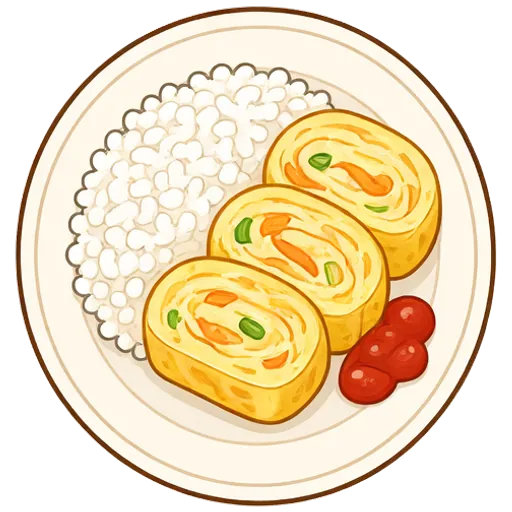
Korean rolled omelette (gyeran-mari) with rice
A tender, golden egg log rolled in thin layers with carrot and green onion, sliced to show its pretty spiral and eaten with warm rice.
- 35 min total
- 20 min hands-on
- A little more hands-on
- Serves 2
- About $1.46 a serving
- 600 calories
- Vegetarian
- Gluten-free
- Dairy-free

Dolly says: Read the steps once before you start. Everything goes smoother after that.
Ingredients
For 2 servings.
- 1 cup long-grain white rice
- 2 green onions, finely chopped
- ¼ cup shredded carrots, finely chopped
- 6 large eggs
- 2 tbsp ketchup (optional)
From your pantry
- 1¼ cups water
- ¼ tsp salt
- 2 tsp vegetable oil
Each serving has about 600 calories, 26 g protein, 78 g carbs and 20 g fat, and costs about $1.46 at typical US grocery prices. Both are estimates from what the recipe uses.
Missing something?
- No long-grain white rice? Jasmine rice or basmati rice works.
- No green onions? Chives work.
- No shredded carrots? Carrots work.
Steps
Tap an underlined word for a quick explanation.
the rice until the water runs almost clear. Put it in a small with the water and over high heat.
Rinse. Rinsing means running cold water over rice or canned beans in a strainer while you swish them around. It washes off loose starch and can liquid, so rice cooks up fluffy and beans taste clean.
How you’ll know: The water running out goes from cloudy to mostly clear; it doesn’t have to be perfect.
Saucepan. A saucepan is a pot with tall, straight sides and one long handle. It’s for things that need depth, like rice, sauces or a few boiled eggs.
How you’ll know: The food fills it about halfway, leaving room to bubble without spilling over.
Bring to a boil. It means heating a liquid on high until it’s fully boiling before you move on. A lid on the pot gets it there faster, which makes it a good moment to chop something.
How you’ll know: Big bubbles break all over the surface, and they keep coming when you lift the lid.
High heat
Cover, turn the heat to low and cook 15 minutes. Turn off the burner and leave the lid on while you make the omelette.
Low heatTimer: 15 min
the green onions and carrot. the eggs and salt until completely smooth, then stir in the vegetables.
Finely chop. Finely chopping means cutting food into small pieces, a little bigger than minced, about the size of a lentil. Small pieces spread their flavor through the dish and cook quickly.
How you’ll know: Nothing is bigger than a lentil, and the pile looks like confetti rather than paste.
Whisk. Whisking means beating quickly with a whisk or a fork to blend things together. It smooths out lumps and mixes eggs, oil or sauces evenly.
How you’ll know: It all looks one even color and texture, with no streaks or lumps.
Heat a 10-inch nonstick over low heat and wipe it with a little oil on a paper towel. Pour in a third of the egg and tilt the pan so it covers the bottom.
Skillet. A skillet is a frying pan: wide and flat with low, sloped sides. The shape lets steam escape, so food browns instead of stewing.
How you’ll know: It’s the pan you’d fry an egg in, and a 10 or 12 inch one handles most recipes.
Low heat
 Dolly’s tip: Low heat keeps it yellow and tender. Brown spots mean the pan is too hot.
When the bottom is set but the top is still a little wet, about 1 minute, roll it up from one side into a log with your spatula and push the log to the edge of the pan.
Low heatTimer: 1 min
Dolly’s tip: It won’t be neat the first time. Each new layer wraps around and hides the mess.Wipe the empty part of the pan with oil and pour in half the remaining egg, lifting the log so egg runs underneath.
When mostly set, roll the log back over it.
Repeat with the last of the egg.
Low heatTimer: 3 min
Cook the log 1 to 2 minutes more, turning it on all sides, until firm and set all the way through.
Low heatTimer: 1 min 30 sec
Food safety: For the safest eggs, cook until the whites are fully set and the yolks begin to thicken. Dishes made with eggs are done at 160°F.
Let it 2 minutes, then into 1-inch pieces. Serve with the rice and ketchup for dipping.
Rest. Resting means letting cooked meat sit for a few minutes before you cut it. It keeps cooking gently, and more of the juice stays in the meat instead of running onto the board.
How you’ll know: Loosely covered with foil, it stays hot, and very little juice runs out when you slice it.
Slice. Slicing means cutting food into flat pieces of about the same thickness. Even slices cook evenly, so none are raw while others burn.
How you’ll know: Lay a few side by side: they’re close to the same thickness from one end to the other.
Timer: 2 min

Plan this in Dollop, and get the grocery list
Dollop puts this dinner on a night that suits your week, lists only what you still need to buy, and walks you through each step while you cook.
More dinners like this
Tofu and egg stir-fry
35 min
Air fryer egg and chips
40 min
Egg fried rice
25 min
Huevos a la cubana (Cuban rice with fried eggs and plantains)
40 min
Vegetarian dinners ›Pantry dinners ›What to make with eggs and rice ›What to make with rice and carrots ›What to make with eggs and carrots ›