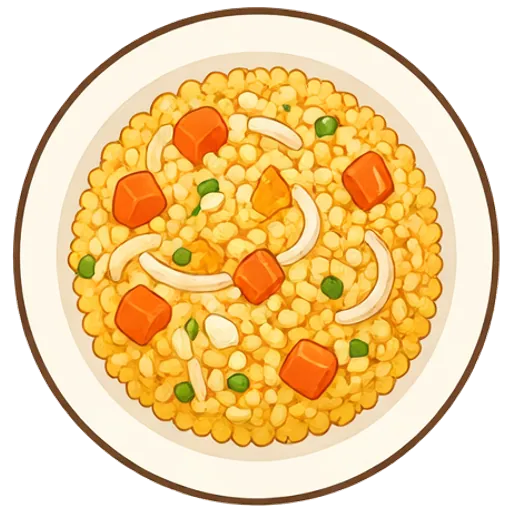
Nigerian fried rice
Party-style Nigerian fried rice, cooked in broth with curry powder and thyme and tossed with carrots, green beans, peas and sweet corn.
- 55 min total
- 25 min hands-on
- Follow-a-recipe easy
- Serves 6
- About $1.14 a serving
- 340 calories
- Good the next day
- Vegan
- Gluten-free
- Dairy-free

Dolly says: Make the full amount. It’s just as good for lunch the next day.
Ingredients
For 6 servings.
- 2 cups long-grain white rice, rinsed
- 3 cups vegetable broth
- 1 tbsp curry powder, divided
- 1 yellow onion, diced
- 2 carrots, diced
- 2 cloves garlic, minced
- 1 cup green beans, cut into ½-inch pieces
- 4 stalks green onions, sliced
- ½ cup frozen peas
- ½ cup frozen corn
From your pantry
- 1 tsp dried thyme, divided
- 1 bay leave
- 1 tsp salt, divided
- 3 tbsp vegetable oil
- ½ tsp black pepper
Each serving has about 340 calories, 7 g protein, 62 g carbs and 8 g fat, and costs about $1.14 at typical US grocery prices. Both are estimates from what the recipe uses.
Missing something?
- No long-grain white rice? Jasmine rice or basmati rice works.
- No yellow onions? White onions or red onions work.
- No green beans? Frozen green beans work.
- No green onions? Chives work.
- No frozen peas? Frozen mixed vegetables work.
- No frozen corn? Canned corn works.
Steps
Tap an underlined word for a quick explanation.
Put the rice, broth, 2 teaspoons curry powder, ½ teaspoon thyme, the bay leaf and ½ teaspoon salt in a large and over high heat.
Saucepan. A saucepan is a pot with tall, straight sides and one long handle. It’s for things that need depth, like rice, sauces or a few boiled eggs.
How you’ll know: The food fills it about halfway, leaving room to bubble without spilling over.
Bring to a boil. It means heating a liquid on high until it’s fully boiling before you move on. A lid on the pot gets it there faster, which makes it a good moment to chop something.
How you’ll know: Big bubbles break all over the surface, and they keep coming when you lift the lid.
High heat
Stir once, cover, turn the heat to low and cook 15 minutes, until the broth is absorbed.
Low heatTimer: 15 min
Fish out the bay leaf and spread the rice on a to cool and dry for 10 minutes.
Sheet pan. A sheet pan is a flat metal baking tray with a low rim all the way around. The rim catches juices, and the wide surface lets food spread out and brown.
How you’ll know: Everything fits in one layer with a little space between the pieces.
Timer: 10 min
 Dolly’s tip: Letting the steam escape keeps the grains separate when you fry them.
Meanwhile, the onion and carrots, the garlic, cut the green beans into ½-inch pieces and the green onions.
Dice. Dicing means cutting food into small, even cubes, usually a quarter to half an inch across. Pieces the same size cook at the same speed, so nothing burns while the rest catches up.
How you’ll know: Your pieces are little cubes about the size of a chickpea, and they all look close to the same.
Mince. Mincing means chopping something into the tiniest pieces you can, smaller than a grain of rice. Tiny pieces melt into the dish, so you get the flavor without biting into a chunk of garlic.
How you’ll know: Every piece is tiny and about the same size, and the pile starts to look almost like a paste.
Slice. Slicing means cutting food into flat pieces of about the same thickness. Even slices cook evenly, so none are raw while others burn.
How you’ll know: Lay a few side by side: they’re close to the same thickness from one end to the other.
Heat the oil in your largest over medium-high heat. Add the onion, carrots and green beans and cook, stirring, 5 minutes, until the carrots are just tender.
Skillet. A skillet is a frying pan: wide and flat with low, sloped sides. The shape lets steam escape, so food browns instead of stewing.
How you’ll know: It’s the pan you’d fry an egg in, and a 10 or 12 inch one handles most recipes.
Medium-high heatTimer: 5 min
Add the garlic, peas, corn and the rest of the curry powder and thyme and stir 2 minutes.
Medium-high heatTimer: 2 min
Add the rice and 4 minutes, it through the vegetables, until everything is hot and evenly yellow.
Stir-fry. Stir-frying means cooking small pieces fast over high heat in a little oil, stirring almost constantly. It moves quickly, so have everything chopped and ready before the pan gets hot.
How you’ll know: It sizzles loudly the whole time, and the vegetables turn bright and tender-crisp in minutes.
Toss. Tossing means gently lifting and turning food so everything gets coated, like pasta in sauce or vegetables in oil. It coats every piece evenly without mashing anything.
How you’ll know: Every piece looks glossy or evenly coated, with no dry spots hiding underneath.
Medium-high heatTimer: 4 min
Dolly’s tip: If your skillet is overflowing, fry it in two batches. A crowded pan steams instead of frying.with the rest of the salt and the pepper, in the green onions and serve.
Season. Seasoning means adding salt, pepper or spices to bring out a food’s flavor. A little at a few stages tastes better than a lot all at the end.
How you’ll know: When you taste it, it tastes bright and like itself, not flat and not salty.
Toss. Tossing means gently lifting and turning food so everything gets coated, like pasta in sauce or vegetables in oil. It coats every piece evenly without mashing anything.
How you’ll know: Every piece looks glossy or evenly coated, with no dry spots hiding underneath.

Plan this in Dollop, and get the grocery list
Dollop puts this dinner on a night that suits your week, lists only what you still need to buy, and walks you through each step while you cook.
More dinners like this
Instant Pot jollof rice
55 min
Vegetable pilau (East African spiced rice)
60 min
Slow cooker Cuban black beans
500 min
Creamy white beans and rice
45 min
Vegetarian dinners ›Make-ahead and freezer-friendly ›What to make with rice and carrots ›What to make with rice and frozen peas ›What to make with frozen peas and carrots ›