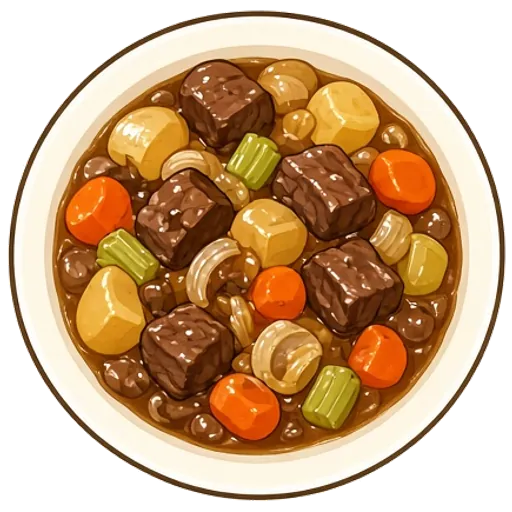
Beef and potato stew
Tender beef, soft potatoes and sweet carrots in a deep, savory broth, the slow Sunday kind of dinner that makes the whole place smell like home.
- 150 min total
- 35 min hands-on
- Follow-a-recipe easy
- Serves 4
- About $6.54 a serving
- 620 calories
- Good the next day
- Gluten-free
- Dairy-free

Dolly says: Make the full amount. It’s just as good for lunch the next day.
Ingredients
For 4 servings.
- 2 lb stew beef
- 1 yellow onion, chopped
- 4 carrots, peeled and cut into 1-inch pieces
- 2 stalks celery, chopped
- 4 cloves garlic, minced
- 2 tbsp tomato paste
- 4 cups beef broth
- 1 tbsp gluten-free tamari
- 1½ lb yukon gold potatoes, cut into 1½-inch chunks
- 1 cup frozen peas (optional)
- 2 tbsp fresh parsley, chopped (optional)
From your pantry
- 2 tsp salt, divided
- 1 tsp black pepper
- 2 tbsp olive oil, divided
- 1 tsp dried thyme
- 2 bay leaves
Each serving has about 620 calories, 54 g protein, 44 g carbs and 27 g fat, and costs about $6.54 at typical US grocery prices. Both are estimates from what the recipe uses.
Missing something?
- No stew beef? Chuck roast works.
- No yellow onions? White onions or red onions work.
- No beef broth? Bone broth or chicken broth works.
- No gluten-free tamari? Soy sauce works.
- No yukon gold potatoes? Russet potatoes or red potatoes work.
- No frozen peas? Frozen mixed vegetables work.
- No fresh parsley? Cilantro works.
Steps
Tap an underlined word for a quick explanation.
the onion and celery, cut the carrots and potatoes into chunks, and the garlic before you start.
Chop. Chopping means cutting food into bite-size pieces that don’t need to be neat. Keep them roughly the same size so everything cooks evenly.
How you’ll know: Your pieces are about half an inch and roughly alike, even if none of them are pretty.
Mince. Mincing means chopping something into the tiniest pieces you can, smaller than a grain of rice. Tiny pieces melt into the dish, so you get the flavor without biting into a chunk of garlic.
How you’ll know: Every piece is tiny and about the same size, and the pile starts to look almost like a paste.
 Dolly’s tip: Keep the cut potatoes in a bowl of cold water so they don’t turn brown while they wait.
the beef dry with paper towels and it all over with 1 tsp of the salt and the pepper.
Pat dry. Patting dry means pressing paper towels onto food to soak up the moisture on its surface. Wet food steams instead of browning, so this is how you get a good sear and crisp skin.
How you’ll know: The surface feels tacky, not wet, and the last paper towel comes away barely damp.
Season. Seasoning means adding salt, pepper or spices to bring out a food’s flavor. A little at a few stages tastes better than a lot all at the end.
How you’ll know: When you taste it, it tastes bright and like itself, not flat and not salty.
Heat 1 tbsp of the oil in a or large heavy pot over medium-high heat until it .
Dutch oven. A Dutch oven is a heavy pot, usually enameled cast iron, with a tight-fitting lid. It holds heat evenly, so it’s great for soups, stews and anything that simmers a long time.
How you’ll know: Any large, heavy pot with a lid does the same job if you don’t have one.
Shimmering oil. Oil shimmers when it’s hot enough to cook: its surface looks rippled and wavy, like heat over a road. That’s your cue to add the food, just before the oil would start to smoke.
How you’ll know: The oil looks wavy and runs thin like water when you tilt the pan, with no smoke yet.
Medium-high heat
half the beef for 6 to 8 minutes, turning each piece only when it’s deep , then move it to a plate and repeat with the rest of the oil and beef.
Sear. Searing means cooking the outside of meat or fish in a hot pan, without moving it, until a deep brown crust forms. The crust is packed with flavor, and it only forms on a dry surface.
How you’ll know: It sizzles loudly the moment it goes in, and it lets go of the pan on its own when the crust is ready.
Brown. Browning means cooking until the outside turns brown, which is where a lot of savory flavor comes from. Give food room and time without stirring, or it steams and stays gray.
How you’ll know: The food looks brown rather than gray, and the kitchen smells toasty and savory.
Medium-high heatTimer: 7 min
Dolly’s tip: It’ll stick at first. When a piece lets go on its own, it’s ready to turn. A crowded pot steams the meat gray.to medium, add the onion, carrots and celery, and cook for 5 minutes, , until the onion .
Reduce the heat. It means turning the burner down, usually to medium-low or low, so food cooks gently instead of hard. Electric burners cool slowly, so lift the pan off for a moment if it’s bubbling hard.
How you’ll know: Within a minute the bubbling calms to a gentle simmer, or the sizzle turns quiet.
Scrape up the browned bits. It means loosening the brown bits stuck to the pan with a wooden spoon, usually right after adding liquid. Those bits are concentrated flavor, and they melt into the sauce.
How you’ll know: The bottom of the pan looks clean again, and the liquid turns darker and richer.
Softened. For vegetables it means cooked until they bend and lose their crunch; for butter, left out until it dents easily. Soft onions taste sweet, and soft butter mixes in smoothly.
How you’ll know: Onions squash easily against the pan with your spoon, and butter dents under a finger without looking greasy.
Medium heatTimer: 5 min
in the garlic and tomato paste and cook for 1 minute, until the paste turns a shade darker.
Stir. Stirring means moving food around with a spoon or spatula so it cooks evenly and doesn’t stick. Unless the recipe says constantly, every so often is plenty, and it gives food time to brown.
How you’ll know: When you drag the spoon across the bottom, nothing is sticking or scorching.
Medium heatTimer: 1 min
Return the beef and its juices, add the broth, tamari, thyme, bay leaves and the rest of the salt, and over high heat.
Bring to a boil. It means heating a liquid on high until it’s fully boiling before you move on. A lid on the pot gets it there faster, which makes it a good moment to chop something.
How you’ll know: Big bubbles break all over the surface, and they keep coming when you lift the lid.
High heat
to low, cover, and for 1 hour 15 minutes, every 20 minutes or so.
Reduce the heat. It means turning the burner down, usually to medium-low or low, so food cooks gently instead of hard. Electric burners cool slowly, so lift the pan off for a moment if it’s bubbling hard.
How you’ll know: Within a minute the bubbling calms to a gentle simmer, or the sizzle turns quiet.
Simmer. Simmering means keeping a liquid just below a boil, with small bubbles rising gently. It cooks food evenly and lets a sauce thicken without scorching on the bottom.
How you’ll know: Small, lazy bubbles break the surface every second or so, and nothing is churning.
Stir. Stirring means moving food around with a spoon or spatula so it cooks evenly and doesn’t stick. Unless the recipe says constantly, every so often is plenty, and it gives food time to brown.
How you’ll know: When you drag the spoon across the bottom, nothing is sticking or scorching.
Low heatTimer: 75 min
Dolly’s tip: You want a lazy bubble here and there. A hard boil makes stew meat tough instead of tender.the potatoes, add them to the pot, cover again, and for 30 to 40 minutes more, until the potatoes and beef are .
Drain. Draining means pouring off liquid, like tipping pasta into a colander or spooning extra fat out of the pan. Pour hot grease into a can or jar, not the sink, where it hardens and clogs the pipes.
How you’ll know: Only a few drips are left, and the food isn’t sitting in a puddle.
Simmer. Simmering means keeping a liquid just below a boil, with small bubbles rising gently. It cooks food evenly and lets a sauce thicken without scorching on the bottom.
How you’ll know: Small, lazy bubbles break the surface every second or so, and nothing is churning.
Fork-tender. Fork-tender means cooked until a fork slides in with almost no push. It’s how you know potatoes, carrots or slow-cooked meat are soft all the way through.
How you’ll know: The fork slides in and out easily, and meat pulls apart with very little effort.
Low heatTimer: 35 min
Dolly’s tip: Stew beef is done when a piece falls apart with a gentle press of a fork. If it’s still chewy, it just needs more time.Food safety: Steak, pork chops and other whole cuts are safe at 145°F in the middle, then let them rest for 3 minutes before cutting.
Fish out the bay leaves, in the peas, and mash a few potato chunks against the pot to the broth, then taste for salt and serve with parsley.
Stir. Stirring means moving food around with a spoon or spatula so it cooks evenly and doesn’t stick. Unless the recipe says constantly, every so often is plenty, and it gives food time to brown.
How you’ll know: When you drag the spoon across the bottom, nothing is sticking or scorching.
Thicken. Thickening means cooking a sauce or soup until it’s less runny, by simmering it down or adding something like cornstarch. A thicker sauce clings to food instead of pooling on the plate.
How you’ll know: It coats the back of a spoon, and a line drawn through it with your finger holds its shape.
Low heat

Plan this in Dollop, and get the grocery list
Dollop puts this dinner on a night that suits your week, lists only what you still need to buy, and walks you through each step while you cook.