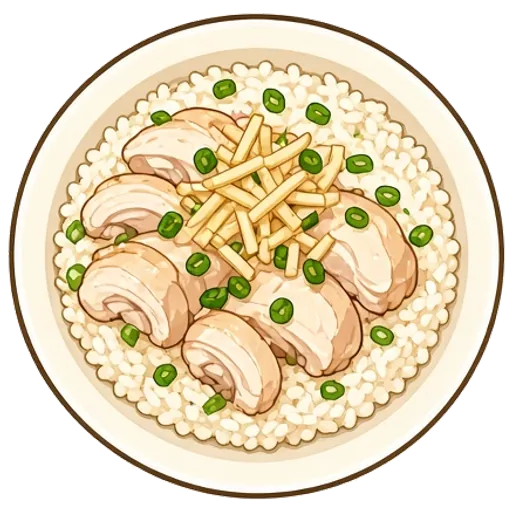
Hainanese-style ginger chicken and rice
Silky poached chicken over rice cooked in its own gingery broth, with a punchy ginger and green onion sauce spooned on top.
- 60 min total
- 25 min hands-on
- Follow-a-recipe easy
- Serves 4
- About $2.98 a serving
- 650 calories
- Good the next day
- Gluten-free
- Dairy-free

Dolly says: Make the full amount. It’s just as good for lunch the next day.
Ingredients
For 4 servings.
- 4 cups chicken broth
- 4 tbsp fresh ginger, peeled, divided
- 4 cloves garlic, divided
- 6 green onions, divided
- 1½ lb boneless chicken thighs, boneless and skinless
- 1½ cups jasmine rice
- 1 cucumber
- 2 tbsp gluten-free tamari
- 1 tsp sesame oil (optional)
From your pantry
- 5 tbsp vegetable oil, divided
- 1½ tsp salt, divided
- 1 tsp rice vinegar
Each serving has about 650 calories, 42 g protein, 63 g carbs and 25 g fat, and costs about $2.98 at typical US grocery prices. Both are estimates from what the recipe uses.
Missing something?
- No chicken broth? Vegetable broth or bone broth works.
- No green onions? Chives work.
- No boneless chicken thighs? Chicken breasts or chicken tenderloins work.
- No jasmine rice? Long-grain white rice or basmati rice works.
- No cucumbers? English cucumbers or mini cucumbers work.
- No gluten-free tamari? Soy sauce works.
Steps
Tap an underlined word for a quick explanation.
Put the broth, 1 tbsp of the ginger cut into thin slices, 2 smashed garlic cloves and 2 whole green onions in a large pot and over high heat.
Bring to a boil. It means heating a liquid on high until it’s fully boiling before you move on. A lid on the pot gets it there faster, which makes it a good moment to chop something.
How you’ll know: Big bubbles break all over the surface, and they keep coming when you lift the lid.
High heat
Add the chicken, to low, and it gently with the lid on for 15 minutes, until it reads 165°F in the thickest piece.
Reduce the heat. It means turning the burner down, usually to medium-low or low, so food cooks gently instead of hard. Electric burners cool slowly, so lift the pan off for a moment if it’s bubbling hard.
How you’ll know: Within a minute the bubbling calms to a gentle simmer, or the sizzle turns quiet.
Poach. Poaching means cooking food gently in liquid that’s hot but barely bubbling. It keeps delicate things like eggs, fish or chicken moist and tender.
How you’ll know: The liquid just shivers, with an occasional small bubble and never a rolling boil.
Low heatTimer: 15 min
 Dolly’s tip: The liquid should barely shiver, never bubble hard. Gentle heat is the whole secret to silky chicken.
Food safety: Chicken is done at 165°F in the thickest part. A thermometer is the only sure check. Without one, cut into the thickest piece: it should be white all the way through, with no pink.
Move the chicken to a plate and cover it loosely with foil, then pour the broth through a strainer into a large measuring cup.
Dolly’s tip: Keep every drop. That broth is what makes the rice taste so good.the rice in a strainer under cold water until it runs mostly clear, and the other 2 garlic cloves.
Rinse. Rinsing means running cold water over rice or canned beans in a strainer while you swish them around. It washes off loose starch and can liquid, so rice cooks up fluffy and beans taste clean.
How you’ll know: The water running out goes from cloudy to mostly clear; it doesn’t have to be perfect.
Mince. Mincing means chopping something into the tiniest pieces you can, smaller than a grain of rice. Tiny pieces melt into the dish, so you get the flavor without biting into a chunk of garlic.
How you’ll know: Every piece is tiny and about the same size, and the pile starts to look almost like a paste.
Heat 1 tbsp of the oil in a over medium heat, add the minced garlic and 1 tbsp of the ginger, grated, and for 1 minute, .
Saucepan. A saucepan is a pot with tall, straight sides and one long handle. It’s for things that need depth, like rice, sauces or a few boiled eggs.
How you’ll know: The food fills it about halfway, leaving room to bubble without spilling over.
Stir. Stirring means moving food around with a spoon or spatula so it cooks evenly and doesn’t stick. Unless the recipe says constantly, every so often is plenty, and it gives food time to brown.
How you’ll know: When you drag the spoon across the bottom, nothing is sticking or scorching.
Fragrant. Fragrant means cooking until you can clearly smell it, usually garlic or spices, often in about 30 seconds. That’s the moment the flavor is ready, just before it can burn.
How you’ll know: You can smell it from a step back, and garlic is pale gold, not brown.
Medium heatTimer: 1 min
Add the rice and for 1 minute to coat it, then pour in 2¼ cups of the strained broth and 1 tsp of the salt and .
Stir. Stirring means moving food around with a spoon or spatula so it cooks evenly and doesn’t stick. Unless the recipe says constantly, every so often is plenty, and it gives food time to brown.
How you’ll know: When you drag the spoon across the bottom, nothing is sticking or scorching.
Bring to a boil. It means heating a liquid on high until it’s fully boiling before you move on. A lid on the pot gets it there faster, which makes it a good moment to chop something.
How you’ll know: Big bubbles break all over the surface, and they keep coming when you lift the lid.
High heat
Dolly’s tip: Measure the broth exactly. Rice is all about the ratio, and extra liquid is what makes it mushy.Cover, turn the heat to low, and cook for 15 minutes without lifting the lid, then turn off the heat and let it for 10 minutes.
Steam. Steaming means cooking food over or in a little simmering water with a lid on to trap the steam. It cooks gently and keeps vegetables bright and tender.
How you’ll know: The color turns vivid, and a fork goes in with just a little resistance.
Low heatTimer: 15 min
Meanwhile, the rest of the ginger into a small bowl and in the other 4 green onions, , the rest of the oil and salt, and the rice vinegar.
Grate. Grating means rubbing food across the holes of a grater to make fine shreds or flakes. It spreads cheese, garlic or ginger evenly through a dish so it melts right in.
How you’ll know: Even shreds fall off the back of the grater, and you stop while the piece is still big enough to hold.
Stir. Stirring means moving food around with a spoon or spatula so it cooks evenly and doesn’t stick. Unless the recipe says constantly, every so often is plenty, and it gives food time to brown.
How you’ll know: When you drag the spoon across the bottom, nothing is sticking or scorching.
Thinly slice. Thinly slicing means cutting slices about an eighth of an inch thick, roughly two coins stacked. Thin slices cook in seconds and soften fast, which quick dishes need.
How you’ll know: A slice bends a little when you hold it by one edge, and slow, steady cuts beat fast ones.
Dolly’s tip: It’s sharp and punchy on its own. Next to the mild chicken and rice, it’s perfect.the chicken and the cucumber, and fluff the rice with a fork.
Slice. Slicing means cutting food into flat pieces of about the same thickness. Even slices cook evenly, so none are raw while others burn.
How you’ll know: Lay a few side by side: they’re close to the same thickness from one end to the other.
Serve the chicken over the rice with the cucumber on the side, a spoonful of the ginger sauce, and a of tamari and sesame oil.
Drizzle. Drizzling means pouring a thin, slow stream over the top of something. A thin stream spreads a little flavor a long way.
How you’ll know: You see thin lines across the food, not a puddle collecting underneath.

Plan this in Dollop, and get the grocery list
Dollop puts this dinner on a night that suits your week, lists only what you still need to buy, and walks you through each step while you cook.
More dinners like this
One-pot smoky chicken and rice
55 min
Cashew chicken stir-fry
40 min
Chicken and rice soup
55 min
One-pot Cajun shrimp and rice
50 min
High-protein dinners ›Cozy comfort food ›What to make with chicken and rice ›What to make with rice and cucumber ›What to make with chicken and cucumber ›