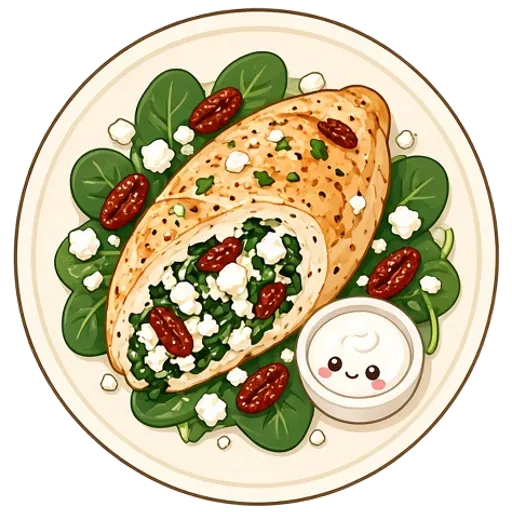
Spinach and feta stuffed chicken
Juicy chicken breasts with a melty spinach, feta and sun-dried tomato filling, golden outside and a little show-off when you cut in.
- 50 min total
- 30 min hands-on
- A little more hands-on
- Serves 4
- About $3.74 a serving
- 490 calories
- Good the next day
- Gluten-free

Dolly says: Make the full amount. It’s just as good for lunch the next day.
Ingredients
For 4 servings.
- 2 cups baby spinach, chopped
- ¾ cup feta cheese, crumbled
- ¼ cup sun-dried tomatoes, chopped
- 2 cloves garlic, minced
- 2 oz cream cheese, softened
- 4 chicken breasts, about 6 oz each
- 1 lemon, cut into wedges
From your pantry
- 1 tsp salt
- ½ tsp black pepper
- 1 tsp paprika
- 1 tsp dried oregano
- 2 tbsp olive oil
Each serving has about 490 calories, 57 g protein, 8 g carbs and 25 g fat, and costs about $3.74 at typical US grocery prices. Both are estimates from what the recipe uses.
Missing something?
- No baby spinach? Kale or arugula works.
- No feta cheese? Goat cheese works.
- No chicken breasts? Boneless chicken thighs or chicken tenderloins work.
- No lemons? Limes work.
Steps
Tap an underlined word for a quick explanation.
the oven to 400°F and line a with .
Preheat. Preheating means turning the oven on before you start, so it’s fully hot when the food goes in. Food that starts in a cold oven cooks unevenly and doesn’t brown the same.
How you’ll know: The oven beeps or its light clicks off, usually 10 to 15 minutes after you turn it on.
Sheet pan. A sheet pan is a flat metal baking tray with a low rim all the way around. The rim catches juices, and the wide surface lets food spread out and brown.
How you’ll know: Everything fits in one layer with a little space between the pieces.
Parchment paper. Parchment paper is a nonstick, oven-safe paper for lining pans. Food lifts right off and cleanup is easy, but don’t swap in wax paper or put parchment under the broiler.
How you’ll know: It lies flat in the pan, and the food slides off when you lift it.
Mix the spinach, feta, sun-dried tomatoes, garlic and cream cheese in a bowl until it holds together.
Lay a chicken breast flat and cut a deep pocket into the thick side with a small sharp knife, stopping ½ inch from the other edges. Repeat with the rest.
 Dolly’s tip: Keep your other hand flat on top and cut slowly. You want a pocket, not two halves.
Food safety: Wash your hands, the board and the knife with hot soapy water after touching raw meat, and don’t rinse raw chicken in the sink.
Stuff each pocket with a quarter of the filling and press the opening closed.
Mix the salt, pepper, paprika and oregano and sprinkle it all over the chicken.
Heat the oil in a large over medium-high heat until it . the chicken for 3 minutes per side, until .
Skillet. A skillet is a frying pan: wide and flat with low, sloped sides. The shape lets steam escape, so food browns instead of stewing.
How you’ll know: It’s the pan you’d fry an egg in, and a 10 or 12 inch one handles most recipes.
Shimmering oil. Oil shimmers when it’s hot enough to cook: its surface looks rippled and wavy, like heat over a road. That’s your cue to add the food, just before the oil would start to smoke.
How you’ll know: The oil looks wavy and runs thin like water when you tilt the pan, with no smoke yet.
Sear. Searing means cooking the outside of meat or fish in a hot pan, without moving it, until a deep brown crust forms. The crust is packed with flavor, and it only forms on a dry surface.
How you’ll know: It sizzles loudly the moment it goes in, and it lets go of the pan on its own when the crust is ready.
Golden brown. Golden brown is the color of good toast, somewhere between yellow and light brown. It means the outside is cooked and crisp but not burnt.
How you’ll know: It looks like toast and smells toasty; dark brown with a bitter smell means it went too far.
Medium-high heatTimer: 6 min
Dolly’s tip: Slide a spatula under the whole breast to turn it, so the filling stays inside.Move the chicken to the and for 15 to 18 minutes, until 165°F in the thickest part of the meat, not the filling.
Sheet pan. A sheet pan is a flat metal baking tray with a low rim all the way around. The rim catches juices, and the wide surface lets food spread out and brown.
How you’ll know: Everything fits in one layer with a little space between the pieces.
Bake. Baking means cooking in the oven with dry heat all around the food. It cooks evenly from every side, so you can mostly leave it alone.
How you’ll know: It’s golden on top and passes the recipe’s check, like a clean toothpick or the right temperature.
Timer: 17 min
Food safety: Chicken is done at 165°F in the thickest part. A thermometer is the only sure check. Without one, cut into the thickest piece: it should be white all the way through, with no pink.
Let it for 5 minutes, then serve whole or in half, with lemon wedges.
Rest. Resting means letting cooked meat sit for a few minutes before you cut it. It keeps cooking gently, and more of the juice stays in the meat instead of running onto the board.
How you’ll know: Loosely covered with foil, it stays hot, and very little juice runs out when you slice it.
Slice. Slicing means cutting food into flat pieces of about the same thickness. Even slices cook evenly, so none are raw while others burn.
How you’ll know: Lay a few side by side: they’re close to the same thickness from one end to the other.
Timer: 5 min

Plan this in Dollop, and get the grocery list
Dollop puts this dinner on a night that suits your week, lists only what you still need to buy, and walks you through each step while you cook.
More dinners like this
Balsamic caprese chicken
35 min
Greek turkey meatballs with tzatziki
45 min
Lemon chicken orzo soup
55 min
Juicy baked chicken with green beans
40 min
High-protein dinners ›Mediterranean dinners ›What to make with spinach and feta cheese ›