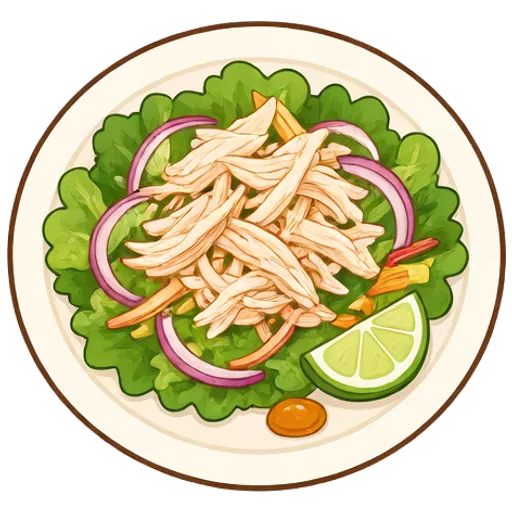
Vietnamese chicken salad (gỏi gà)
Gently poached chicken and crunchy cabbage tossed with fresh herbs, peanuts and a sweet, sour, salty lime dressing, light but filling.
- 45 min total
- 25 min hands-on
- Follow-a-recipe easy
- Serves 4
- About $2.42 a serving
- 340 calories
- Good the next day
- Gluten-free
- Dairy-free

Dolly says: Make the full amount. It’s just as good for lunch the next day.
Ingredients
For 4 servings.
- 1¼ lb boneless chicken thighs
- 1 fresh ginger, sliced into coins
- ½ red onion, thinly sliced
- 3 tbsp fish sauce
- 2 limes, juiced
- 2 cloves garlic, minced
- ½ head green cabbage, very thinly sliced
- 1 cup shredded carrots
- ½ cup cilantro, leaves
- ¼ cup fresh mint, leaves (optional)
- ⅓ cup peanuts, chopped
From your pantry
- 1 tsp salt
- 2 tbsp rice vinegar
- 2 tbsp sugar
- ¼ tsp red pepper flakes
Each serving has about 340 calories, 34 g protein, 27 g carbs and 12 g fat, and costs about $2.42 at typical US grocery prices. Both are estimates from what the recipe uses.
Missing something?
- No boneless chicken thighs? Chicken breasts or chicken tenderloins work.
- No red onions? White onions or yellow onions work.
- No limes? Lemons work.
- No green cabbage? Red cabbage or coleslaw mix works.
- No shredded carrots? Carrots work.
- No cilantro? Fresh parsley works.
Steps
Tap an underlined word for a quick explanation.
Put the chicken, ginger and salt in a , cover with cold water by an inch and on high.
Saucepan. A saucepan is a pot with tall, straight sides and one long handle. It’s for things that need depth, like rice, sauces or a few boiled eggs.
How you’ll know: The food fills it about halfway, leaving room to bubble without spilling over.
Bring to a boil. It means heating a liquid on high until it’s fully boiling before you move on. A lid on the pot gets it there faster, which makes it a good moment to chop something.
How you’ll know: Big bubbles break all over the surface, and they keep coming when you lift the lid.
High heat
Turn the heat to low so it barely bubbles, cover and 15 minutes, until the thickest piece reads 165°F.
Simmer. Simmering means keeping a liquid just below a boil, with small bubbles rising gently. It cooks food evenly and lets a sauce thicken without scorching on the bottom.
How you’ll know: Small, lazy bubbles break the surface every second or so, and nothing is churning.
Low heatTimer: 15 min
 Dolly’s tip: Gentle bubbles keep poached chicken silky. A hard boil makes it tough.
Food safety: Chicken and turkey are done at 165°F in the thickest part. A thermometer is the only sure check. Without one, cut into the thickest piece: it should be white all the way through, with no pink.
Lift the chicken onto a plate to cool for 10 minutes, then it into thin strips.
Shred. Shredding means making thin strips, either on the big holes of a grater or by pulling cooked meat apart with two forks. Shreds soak up sauce and mix evenly through a dish.
How you’ll know: Cooked chicken pulls apart into strands with little effort, and cheese comes off in long, loose strips.
Timer: 10 min
While it cools, the onion with the rice vinegar and leave it to .
Toss. Tossing means gently lifting and turning food so everything gets coated, like pasta in sauce or vegetables in oil. It coats every piece evenly without mashing anything.
How you’ll know: Every piece looks glossy or evenly coated, with no dry spots hiding underneath.
Slice. Slicing means cutting food into flat pieces of about the same thickness. Even slices cook evenly, so none are raw while others burn.
How you’ll know: Lay a few side by side: they’re close to the same thickness from one end to the other.
Softened. For vegetables it means cooked until they bend and lose their crunch; for butter, left out until it dents easily. Soft onions taste sweet, and soft butter mixes in smoothly.
How you’ll know: Onions squash easily against the pan with your spoon, and butter dents under a finger without looking greasy.
the fish sauce, lime juice, sugar, garlic and pepper flakes until the sugar dissolves.
Stir. Stirring means moving food around with a spoon or spatula so it cooks evenly and doesn’t stick. Unless the recipe says constantly, every so often is plenty, and it gives food time to brown.
How you’ll know: When you drag the spoon across the bottom, nothing is sticking or scorching.
the cabbage as thin as you can, pick the herb leaves and the peanuts.
Slice. Slicing means cutting food into flat pieces of about the same thickness. Even slices cook evenly, so none are raw while others burn.
How you’ll know: Lay a few side by side: they’re close to the same thickness from one end to the other.
Chop. Chopping means cutting food into bite-size pieces that don’t need to be neat. Keep them roughly the same size so everything cooks evenly.
How you’ll know: Your pieces are about half an inch and roughly alike, even if none of them are pretty.
Dolly’s tip: Cut the cabbage into quarters, lay each one flat and shave thin slices off the cut edge.In a big bowl, the cabbage, carrots, onion with its vinegar, chicken and herbs with the dressing.
Toss. Tossing means gently lifting and turning food so everything gets coated, like pasta in sauce or vegetables in oil. It coats every piece evenly without mashing anything.
How you’ll know: Every piece looks glossy or evenly coated, with no dry spots hiding underneath.
Scatter the peanuts over the top and serve.
Dolly’s tip: Cabbage stays crunchy in the dressing for 2 days, so it packs well. Keep the peanuts in a little bag and add them at lunch.

Plan this in Dollop, and get the grocery list
Dollop puts this dinner on a night that suits your week, lists only what you still need to buy, and walks you through each step while you cook.
More dinners like this
Grilled chicken thighs
50 min
Baked boneless chicken thighs
35 min
Air fryer chicken thighs
25 min
Smoky chicken and sweet potato sheet pan
50 min
High-protein dinners ›Make-ahead and freezer-friendly ›What to make with chicken and carrots ›What to make with carrots and green cabbage ›