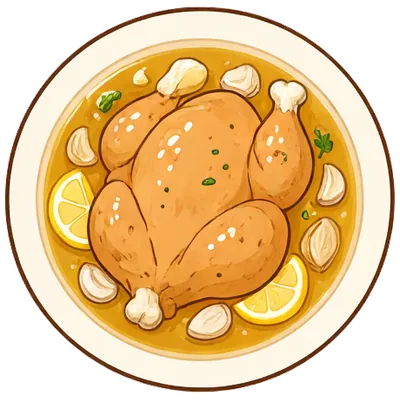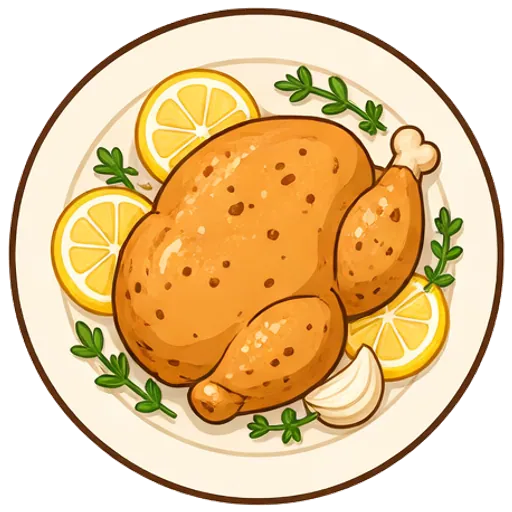
Roast chicken
A golden, garlic-butter roast chicken is less work than it looks, and it feeds you tonight and hands you leftovers for days.
- 110 min total
- 20 min hands-on
- Follow-a-recipe easy
- Serves 4
- About $2.52 a serving
- 760 calories
- Good the next day
- Gluten-free

Dolly says: Make the full amount. It’s just as good for lunch the next day.
Ingredients
For 4 servings.
- 1 whole chicken, about 4 lb
- 3 tbsp butter, softened
- 4 cloves garlic, minced
- 6 sprigs fresh thyme
- 1 lemon
- 1 yellow onion, cut into thick slices
From your pantry
- 2 tsp salt, divided
- 1 tsp black pepper, divided
Each serving has about 760 calories, 58 g protein, 7 g carbs and 55 g fat, and costs about $2.52 at typical US grocery prices. Both are estimates from what the recipe uses.
Missing something?
- No butter? Ghee works.
- No lemons? Limes work.
- No yellow onions? White onions or red onions work.
Steps
Tap an underlined word for a quick explanation.
Take the butter out of the fridge to and the oven to 425°F with a rack in the middle.
Softened. For vegetables it means cooked until they bend and lose their crunch; for butter, left out until it dents easily. Soft onions taste sweet, and soft butter mixes in smoothly.
How you’ll know: Onions squash easily against the pan with your spoon, and butter dents under a finger without looking greasy.
Preheat. Preheating means turning the oven on before you start, so it’s fully hot when the food goes in. Food that starts in a cold oven cooks unevenly and doesn’t brown the same.
How you’ll know: The oven beeps or its light clicks off, usually 10 to 15 minutes after you turn it on.
Pull the bag of giblets out of the chicken and throw it away, then the chicken very dry inside and out with paper towels.
Pat dry. Patting dry means pressing paper towels onto food to soak up the moisture on its surface. Wet food steams instead of browning, so this is how you get a good sear and crisp skin.
How you’ll know: The surface feels tacky, not wet, and the last paper towel comes away barely damp.
 Dolly’s tip: Check both ends. The little bag is often tucked into the neck end.
Food safety: Wash your hands, the board and the knife with hot soapy water after touching raw meat, and don’t rinse raw chicken in the sink.
Strip the leaves from 4 thyme sprigs into a small bowl and mash them with the butter, garlic, 1 teaspoon of salt and ½ teaspoon of pepper.
Slide your fingers under the skin over the breast to loosen it, push half the butter under the skin, and rub the other half all over the outside.
Dolly’s tip: Work slowly from the open end. If the skin tears a little, it still roasts beautifully.Sprinkle the remaining salt and pepper over the skin. the lemon and push both halves into the cavity with the last 2 thyme sprigs.
Halve. Halving means cutting something into two equal pieces. Even halves cook at the same speed, so one doesn’t dry out while the other finishes.
How you’ll know: The two pieces look like mirror images of each other.
Lay the onion slices in the middle of a 9x13 baking dish and set the chicken on top, breast side up.
Dolly’s tip: The onion lifts the chicken out of its juices so the bottom roasts instead of stewing, and it turns sweet in the drippings.65 to 75 minutes, until the skin is deep and the thickest part of the thigh, not touching bone, reads 165°F.
Roast. Roasting means cooking in a hot oven, around 400°F to 450°F, usually spread out on a sheet pan. The dry heat browns the outside and brings out sweetness, especially in vegetables.
How you’ll know: The edges are browned and a little crisp, and a fork slides easily into the thickest piece.
Golden brown. Golden brown is the color of good toast, somewhere between yellow and light brown. It means the outside is cooked and crisp but not burnt.
How you’ll know: It looks like toast and smells toasty; dark brown with a bitter smell means it went too far.
Timer: 65 min
Dolly’s tip: No thermometer? Cut where the thigh meets the body. The juice should run clear with no pink in the meat.Food safety: Chicken and turkey are done at 165°F in the thickest part. A thermometer is the only sure check. Without one, cut into the thickest piece: it should be white all the way through, with no pink.
Move the chicken to a board and let it for 15 minutes.
Rest. Resting means letting cooked meat sit for a few minutes before you cut it. It keeps cooking gently, and more of the juice stays in the meat instead of running onto the board.
How you’ll know: Loosely covered with foil, it stays hot, and very little juice runs out when you slice it.
Timer: 15 min
Dolly’s tip: Resting keeps the juice in the meat instead of on the board. It stays hot for a good 20 minutes.Cut off the legs and wings, the breast meat, and spoon the pan juices and soft onions over everything.
Slice. Slicing means cutting food into flat pieces of about the same thickness. Even slices cook evenly, so none are raw while others burn.
How you’ll know: Lay a few side by side: they’re close to the same thickness from one end to the other.

Plan this in Dollop, and get the grocery list
Dollop puts this dinner on a night that suits your week, lists only what you still need to buy, and walks you through each step while you cook.