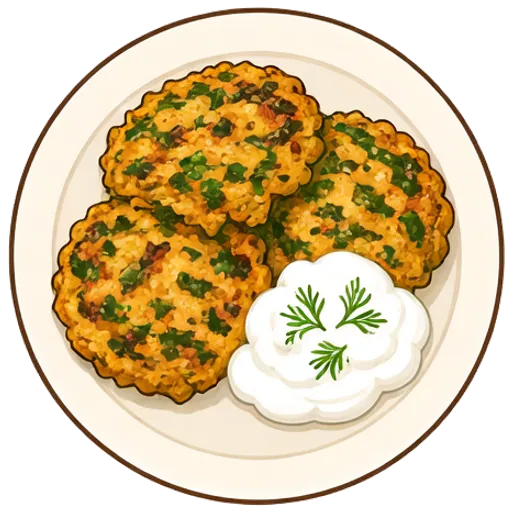
Zucchini fritters with garlic yogurt
Crisp-edged zucchini and feta fritters flecked with dill and green onion, dunked in a cool, garlicky yogurt sauce.
- 40 min total
- 30 min hands-on
- Follow-a-recipe easy
- Serves 2
- About $5.02 a serving
- 670 calories
- Vegetarian

Dolly says: Read the steps once before you start. Everything goes smoother after that.
Ingredients
For 2 servings.
- 2 zucchini, medium, about 1 lb
- 3 green onions
- 3 tbsp fresh dill, chopped, divided
- 2 cloves garlic, minced, divided
- ¾ cup feta cheese, crumbled
- 3 large eggs
- ¾ cup plain Greek yogurt
- 1 lemon, cut into wedges
From your pantry
- ¾ tsp salt
- ½ cup all-purpose flour
- ¼ tsp black pepper
- 3 tbsp olive oil, divided
Each serving has about 670 calories, 33 g protein, 42 g carbs and 42 g fat, and costs about $5.02 at typical US grocery prices. Both are estimates from what the recipe uses.
Missing something?
- No zucchini? Yellow squash works.
- No green onions? Chives work.
- No feta cheese? Goat cheese works.
- No plain Greek yogurt? Plain yogurt or sour cream works.
- No lemons? Limes work.
Steps
Tap an underlined word for a quick explanation.
the zucchini on the large holes of a box grater. it with the salt in a colander set in the sink and let it sit for 10 minutes.
Grate. Grating means rubbing food across the holes of a grater to make fine shreds or flakes. It spreads cheese, garlic or ginger evenly through a dish so it melts right in.
How you’ll know: Even shreds fall off the back of the grater, and you stop while the piece is still big enough to hold.
Toss. Tossing means gently lifting and turning food so everything gets coated, like pasta in sauce or vegetables in oil. It coats every piece evenly without mashing anything.
How you’ll know: Every piece looks glossy or evenly coated, with no dry spots hiding underneath.
Timer: 10 min
 Dolly’s tip: Salt pulls the water out. Skip this and the fritters fall apart in the pan.
Meanwhile, the green onions, the dill, the garlic and the feta. Save a third of the dill and half the garlic for the sauce.
Slice. Slicing means cutting food into flat pieces of about the same thickness. Even slices cook evenly, so none are raw while others burn.
How you’ll know: Lay a few side by side: they’re close to the same thickness from one end to the other.
Chop. Chopping means cutting food into bite-size pieces that don’t need to be neat. Keep them roughly the same size so everything cooks evenly.
How you’ll know: Your pieces are about half an inch and roughly alike, even if none of them are pretty.
Mince. Mincing means chopping something into the tiniest pieces you can, smaller than a grain of rice. Tiny pieces melt into the dish, so you get the flavor without biting into a chunk of garlic.
How you’ll know: Every piece is tiny and about the same size, and the pile starts to look almost like a paste.
Crumble. Crumbling means breaking food into small, rough bits with your fingers or a spoon, like feta or ground meat in the pan. Small bits spread through the dish, so there’s some in every bite.
How you’ll know: The pieces are small and uneven, about pea-size, with no big clumps left.
Squeeze the zucchini in a clean dish towel over the sink until it’s very dry and about half the size.
In a bowl, mix the zucchini, eggs, flour, feta, green onions, dill, garlic and pepper into a thick batter.
Heat 2 tablespoons oil in a large nonstick over medium heat until it . Drop in scant ¼-cup mounds and press them to about ½ inch thick.
Skillet. A skillet is a frying pan: wide and flat with low, sloped sides. The shape lets steam escape, so food browns instead of stewing.
How you’ll know: It’s the pan you’d fry an egg in, and a 10 or 12 inch one handles most recipes.
Shimmering oil. Oil shimmers when it’s hot enough to cook: its surface looks rippled and wavy, like heat over a road. That’s your cue to add the food, just before the oil would start to smoke.
How you’ll know: The oil looks wavy and runs thin like water when you tilt the pan, with no smoke yet.
Medium heat
Cook until deep underneath, 3 to 4 minutes, then flip and cook until firm in the middle, 3 minutes more. Add the last tablespoon of oil for the second batch.
Golden brown. Golden brown is the color of good toast, somewhere between yellow and light brown. It means the outside is cooked and crisp but not burnt.
How you’ll know: It looks like toast and smells toasty; dark brown with a bitter smell means it went too far.
Medium heatTimer: 7 min
Dolly’s tip: Flip only when the edges look set and the bottom is well browned, or they’ll tear.Food safety: For the safest eggs, cook until the whites are fully set and the yolks begin to thicken. Dishes made with eggs are done at 160°F.
Stir together the yogurt, the rest of the garlic and dill, a squeeze of lemon and of salt. Serve the fritters hot with the sauce and lemon wedges.
Pinch. A pinch is what you can hold between your thumb and two fingers, less than an eighth of a teaspoon. It’s a small, forgiving amount, so there’s no need to measure.
How you’ll know: It’s a light sprinkle you can barely see on the food, not a little pile.

Plan this in Dollop, and get the grocery list
Dollop puts this dinner on a night that suits your week, lists only what you still need to buy, and walks you through each step while you cook.
More dinners like this
Turkish eggs on garlicky yogurt
25 min
Lentils with roasted red peppers and feta
35 min
Garlicky white beans and spinach with fried eggs
25 min
Greek pita pizzas
20 min
High-protein dinners ›Vegetarian dinners ›What to make with eggs and zucchini ›